

What Is a Smart Bat—And Should Your Kid Use One?
Introduction:
Once upon a time, all a kid needed was a bat, a ball, and a patch of grass.
Today? You’ve got bats that track swing speed, apps that analyze attack angle, and gear promising to turn your Little Leaguer into a launch-angle machine.
Enter the smart bat—part training tool, part tech gadget, and totally changing how young hitters learn the game.
In this post, we break down exactly what a smart bat is, how it works, and who it’s right for.
This page contains affiliate links and I earn a commission if you make a purchase through one of the links, at no cost to you. As an Amazon Associate I earn from qualifying purchases.

Not Your Average Bat
Forget what you know about old-school wood or alloy sticks.
A smart bat isn’t just a bat—it’s a training tool with brains.
Packed with embedded sensors or paired with external swing trackers, smart bats measure real-time swing metrics like bat speed, attack angle, and time to contact.
❓ So… What Is a Smart Bat?
At its core, a smart bat uses built-in technology (or a connected sensor) to track how your player swings.
That data—usually sent to a mobile app—shows key metrics like:
- Bat speed – How fast the bat is moving when it makes contact with the ball. More speed = more power.
- Swing path/attack angle – The angle of the bat as it moves through the hitting zone. Too steep? You might pop it up. Too flat? Ground balls all day.
- Time to contact – How long it takes from the start of the swing to when the bat hits the ball. Shorter time = quicker hands.

Some models, like the Blast Motion, attach sensors to any bat. Others, like the Marucci CATX Smart Bat, have sensors built in from the start.
🥇 What’s the Purpose?
It’s all about feedback. Smart bats show players how they’re swinging—not just how it feels. That helps coaches and parents identify issues like:
- A late bat
- Poor launch angle
- Inconsistent swing paths
And for kids? It turns hitting into a fun, data-driven game they can actually improve at.
🧠 How Can It Help Jr.?
Let’s say your kid keeps popping the ball up.
With a smart bat, you might see their attack angle is too steep.
Or maybe they’re swinging late against faster pitching. Now you have the why behind the result.
It’s also great for building consistency.
Kids can work toward measurable goals: better bat speed, tighter swing paths, quicker time to contact.
And for visual learners?
Apps give them instant graphs and videos to break things down.
🧣 Who’s It Right For?
Smart bats are perfect for:
- Little Leaguers who want to improve quickly
- High school players aiming to impress scouts
- Parents & coaches who want actionable feedback
But let’s be real: it’s not for everyone.
If your son is still learning how to make contact, stick with the fundamentals first.
Smart bats are best for players who already have some rhythm at the plate and want to improve.
📈 Top Smart Bats & Sensors (2025 Picks)
Most smart bats and sensors are designed for training only—meaning they can’t be used in games.
They’re designed for training—practices, batting cages, ands tee work. However, the Marucci CATX Smart Bat is a rare exception: it’s currently the only smart bat approved for use in official youth games.
Always check with your league’s bat rules before bringing one to the field.
Here are a few of the top performers in the market—backed by players, coaches, and affiliate partnerships:
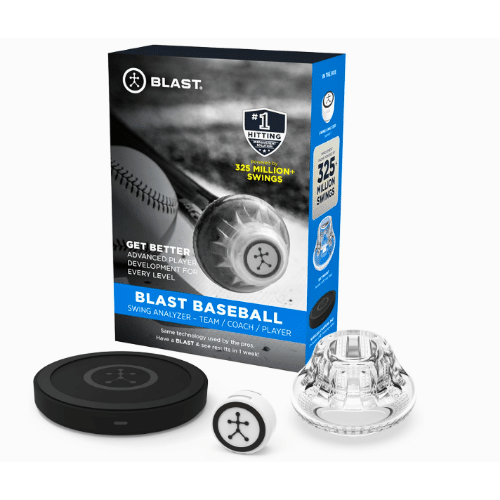
1. Blast Motion Bat Sensor
The Blast Motion Bat Sensor stands out for its user-friendly setup, robust swing metrics, and seamless smartphone integration.
It delivers real-time feedback on key elements like bat speed, attack angle, and rotational acceleration, making it a valuable tool for both players and coaches looking to sharpen swing mechanics and track progress.
The sensor is lightweight and barely noticeable—especially when worn with batting gloves—and it charges wirelessly for added convenience.
The Blast app is intuitive, offering instant feedback and the ability to pair swing data with video, making analysis easy and visual.
Even better: Blast auto-calibrates, meaning there’s no technical setup—perfect for younger players or parents who don’t want a tech headache.
Bottom Line:
Blast Motion is one of the most accessible and well-supported swing analyzers on the market.
It’s especially useful for players who want actionable feedback without complicated setup—but should always be paired with smart coaching, not used as a solo guide.
Pros and Cons
2. Diamond Kinetics SwingTracker
The Diamond Kinetics SwingTracker is a powerhouse for hitters and coaches who crave in-depth swing analysis.
It delivers an impressive range of metrics—including hand path, impact momentum, and 3D swing modeling—going beyond the basics offered by most competitors.
The app is cleanly designed and allows users to track performance over time, compare against national benchmarks, or even create leaderboards for teams.
Multiplayer support and group data sharing make it a great fit for high school programs or clinics.
Players also get access to DK Experts (with a subscription), which unlocks custom coaching tips, drills, and improvement plans tailored to their swing profile.
Wireless charging and both real-time and post-swing feedback round out a feature-rich training tool.
Th